
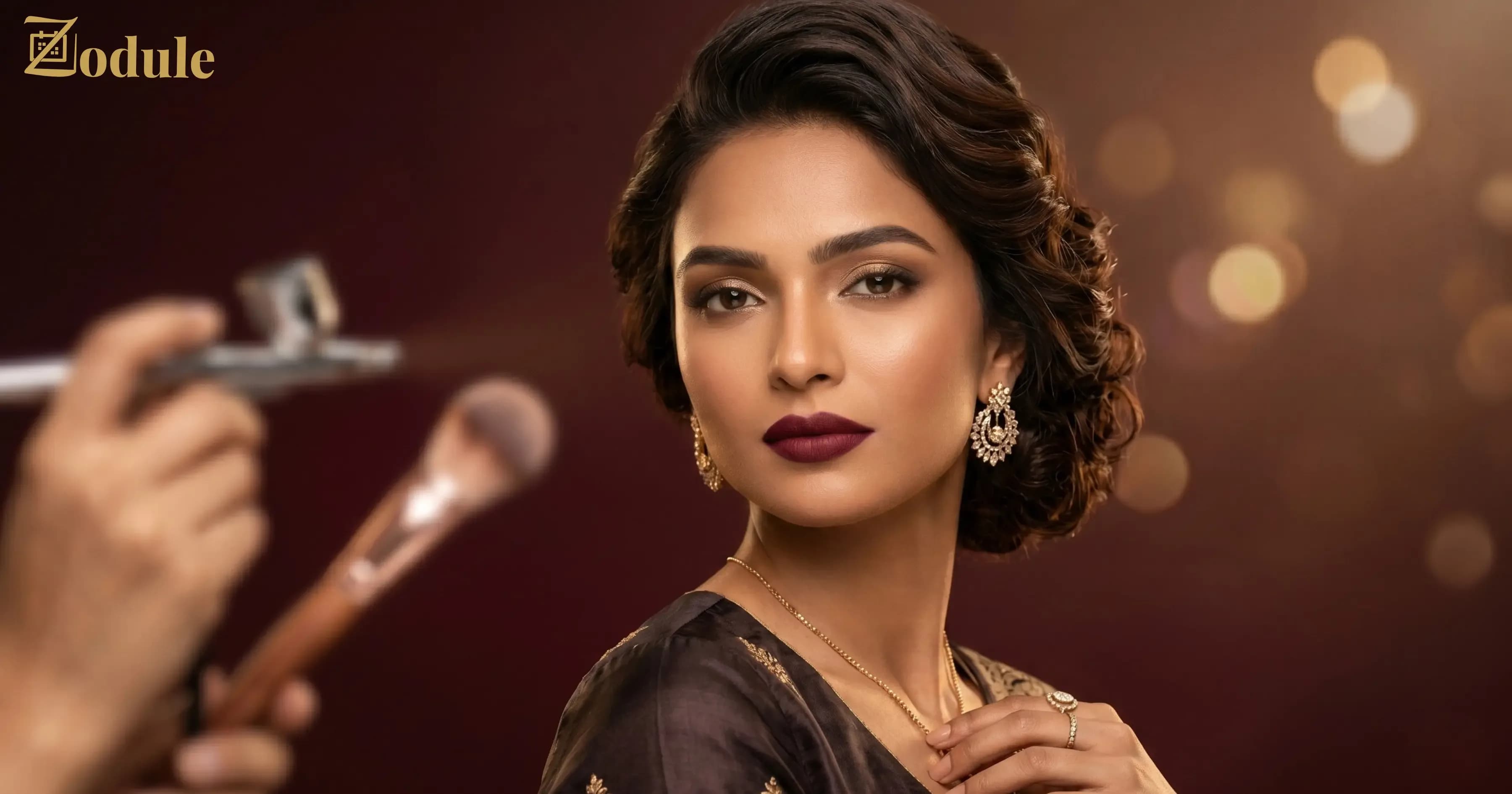
HD Makeup vs. Airbrush Makeup: Which Is Worth the Premium Price?
By Zodule Editorial · 6/1/2026 · 7 min read
The Bride Whose Makeup Cracked Before the Pheras
She'd paid ₹35,000 for airbrush makeup. Top-rated artist, great reviews, beautiful portfolio. And by the time the wedding mandap was set up, barely four hours in, the foundation along her smile lines had started gathering like tiny fault lines. The photos from the haldi ceremony? Gorgeous. The reception close-ups? You could see every crack.
I've seen this happen more than once. Not because airbrush is bad, but because nobody told her that her dry, textured skin and a silicone-based formula in peak Delhi summer were a terrible match. The technique was flawless. The decision wasn't.
That's the gap this guide fills. By the end, you'll know exactly which makeup method, HD or airbrush, is worth the premium for your specific event, skin, and conditions, so you're not paying more for a worse result.
Before You Decide: The One-Sentence Readiness Test
Here's your stop/go check: Can you describe your event's biggest skin challenge and its duration in one sentence?
Something like: "I have acne scarring, and my sangeet is a 10-hour outdoor event in Mumbai's July humidity."
If you can't articulate that, no artist, HD or airbrush, can make the right call for you. Lock this down first. Everything flows from here.
Phase 1: Understand What You're Actually Paying For
Let's kill a misconception. "HD" and "airbrush" aren't quality tiers. They're application methods with different strengths.
HD makeup uses brushes, sponges, and fingers. The products contain light-diffusing particles designed to scatter light under cameras and studio flash. You get buildable coverage, which means your artist can go sheer on your forehead and heavier on that stubborn pigmentation near your chin. It's targeted. It's flexible.
Airbrush makeup uses an air compressor setup that pushes product through a gun as an atomized mist. The result is an ultra-even, thin veil across the skin. Most formulas are silicone-based, which is why they tend to resist sweat and humidity better.
Here's the real cost picture from the Indian market:
HD typically runs ₹10,000–₹25,000
Airbrush sits at ₹15,000–₹40,000
That premium isn't just for the "airbrush" label. It's for the equipment, the specialized formula, and, honestly, the skill floor required to operate pressure control without making you look like a mannequin.
Visual Checkpoint: If someone's quoting you airbrush prices but can't show you their compressor setup or explain their layering pass technique, that's a red flag.
Verification: Ask the artist one question: "What base formula do you use, and why does it suit my skin type?" If they can't answer specifically, keep looking.
Phase 2: Match the Method to Your Event Reality
This is where most people get it wrong. They pick based on Instagram reels instead of their actual event conditions.
Choose HD when:
You have texture irregularities (acne marks, dry patches, fine lines) that need spot correction, not blanket coverage
Your event is under 8 hours
You want a soft-focus finish that looks like skin, not a filter
You need the flexibility to adjust coverage zones, lighter here, more pore-blurring there
Choose airbrush when:
Your event is 12+ hours (think: full Indian wedding day from haldi to reception)
You're in high-humidity conditions where weather resistance is non-negotiable
Your skin is relatively smooth and well-prepped
You want speed, airbrush application can be faster once the setup is ready
Visual Checkpoint: Imagine your event at hour 8. Are you still taking photos? Still dancing? If yes, longevity matters more than finish control. If your main photos happen in the first 3 hours, finish control wins.
Verification: Map your event timeline. Mark every photo-heavy moment. If they cluster early, HD's shorter touch-up window is fine. If they're spread across 12–16 hours, airbrush's long-wear formula earns its premium.
The data backs this up: HD typically holds 8–10 hours, while airbrush can push 12–16 hours under the right conditions. But "right conditions" is doing a lot of heavy lifting in that sentence.
Phase 3: The Skin Prep That Actually Determines Your ROI
Here's what I wish more people understood, the ROI on your makeup investment is decided before the first brush stroke or spray pass.
Both methods fail on poorly prepped skin. But they fail differently.
For HD: Skip moisturizer on oily zones and your base slides. Over-powder and you get cakeyness that shows up in every candid shot. The fix is simple but specific: hydrate dry zones, mattify oily zones, and prime selectively.
For airbrush: The atomized mist sits on top of skin texture. If you have dry patches, the mist will cling to them and make them more visible, not less. A sensitive/acne-prone skin protocol matters here, hydrate aggressively 48 hours before, and avoid any new actives that might cause flaking.
Visual Checkpoint: After primer, before foundation, press a tissue against your cheek. If it sticks and pulls, you're too tacky. If it slides off clean, you're ready. The surface should feel like smooth, set paper.
Verification: Photograph your prepped skin under flash. If you can already see dry patches or excessive shine, no application method will save you. Fix the prep first.
Your Event, Your Artist, Matched Right Finding a makeup artist who actually understands this skin-prep-to-method match? That's half the battle. On Zodule, you can browse curated beauty professionals who specialize in bridal and event makeup, with real portfolios, so you're booking skill, not just a label. Book beautifully, and book informed.
The Ugly Truth: Problems Nobody Warns You About
Most issues aren't about HD vs. airbrush. They're about artist skill, formula compatibility, and conditions. Here's what actually goes wrong, and the fixes that work.
Problem | The Weird Fix | Why It Works |
|---|---|---|
Airbrush looks patchy on one side | Reduce product load, increase spray distance, use thinner layering passes | Heavy single passes create uneven deposits; multiple thin passes build evenly |
HD looks cakey in daylight photos | Stop adding product entirely; switch to spot correction only | Over-application is almost always the cause, not the product itself |
Makeup melts by hour 6 in humidity | Switch to a long-wear, weather-resistant formula and use a stronger setting routine | It's usually a formula mismatch, not a method failure |
Airbrush feels tight and dry on textured skin | Prioritize hydration in prep; skip matte finishing products | The fine mist emphasizes dryness, you need to solve it at the skin level |
Re-blending airbrush ruins the finish | Fix errors with micro-layers, not by rubbing or blending large areas | Airbrush sets quickly; reworking it like traditional makeup destroys the veil |
FAQ: The Questions That Actually Matter
How long does airbrush makeup really last compared to HD?
Airbrush typically holds 12–16 hours; HD sits around 8–10 hours. But these numbers assume proper skin prep and formula matching. A poorly prepped airbrush application can break down faster than a well-executed HD base. The method matters less than the execution and the conditions.
Is airbrush makeup worth the extra ₹10,000–₹15,000 for a wedding?
If your event runs 10+ hours in heat or humidity, yes, the longevity and weather resistance justify the cost. For a 4-hour indoor reception with heavy photography, HD's finish control and buildable coverage often deliver better value for close-up shots.
Can airbrush work on acne-prone or textured skin?
It can, but it requires a skilled artist who understands the sensitive/acne-prone skin protocol. The non-contact application is actually gentler, but the atomized mist can highlight texture if skin isn't prepped correctly. Hydration is everything here.
How do I know if my artist is actually skilled at airbrush?
Ask to see their air compressor setup and watch them demonstrate pressure control. If the spray pattern is inconsistent or they can't adjust flow mid-application, the technique isn't there yet, regardless of their pricing.
What's the biggest mistake brides make when choosing between HD and airbrush?
Choosing based on trend or price instead of matching the method to their skin type, event duration, and weather conditions. A ₹40,000 airbrush job on the wrong skin in the wrong conditions will underperform a ₹15,000 HD application done right.
So, Which Premium Are You Actually Paying For?
Stop thinking about HD vs. airbrush as "good vs. better." Think about it as two tools built for different jobs. The premium is only worth it when the method matches your skin, your event's demands, and your artist's actual skill with that technique.
The smartest investment? An artist who'll tell you which method is wrong for you, even if it means a lower invoice.
Ready to Find That Artist? Browse vetted beauty professionals on Zodule who specialize in both HD and airbrush techniques, so you're choosing based on fit, not guesswork.
Zodule Editorial